
01.23.26
Roe v Wade: Don't rest in peace

Yesterday, January 22, was the 53rd anniversary of Roe v Wade (January 22, 1973), the Supreme Court case that conferred Constitutional protection on the right to abortion, a cornerstone of women’s existential equality.
That protection, and that equality, were nullified by SCOTUS’s conservative majority in Dobbs v Jackson Women’s Health Organization, on June 24, 2022. Since then, at least 20 states have totally or nearly banned abortion, affecting roughly 28 million women and girls of childbearing age.
Two major things have happened since Dobbs. The number of abortions nationwide has not diminished; in fact, it has increased. That is thanks to broadening public awareness of abortion pills, blue state providers protected by shield laws prescribing and shipping them into red states, and a smoothly running feminist pill-access underground distributing them free or at low cost.
The other development since Dobbs is that pregnancy in ban states is increasingly a fatal condition. An analysis of data through 2023 by the Gender Equity Policy Institute found that mothers living in states that banned abortion were nearly twice as likely to die during pregnancy, childbirth, or soon after giving birth as those in abortion-supportive states. Researchers at a June 9, 2025 symposium on the health impacts of abortion bans reported that since Dobbs, ban states have seen over 22,000 additional births, 478 excess infant deaths, and 59 excess pregnancy-associated deaths.
Meanwhile, maternal mortality fell 21 percent in states where abortion remained legally protected and accessible.
Roe ranks with the Voting Rights Act, the Americans with Disabilities Act, and the legalization of gay marriage as a milestone of liberation in American history.
Yet the New York Times did not mark the anniversary of Roe v Wade. Nor did the New Republic or the Nation, Reuters or USA Today. Even The 19th News, which covers reproductive justice and health probably more thoroughly than any other publication, did not mention it.
The right has not forgotten, however. In fact the little abortion-related news there was this week concerned opponents’ renewed pressure on Congress to enact a federal ban on abortion pills.
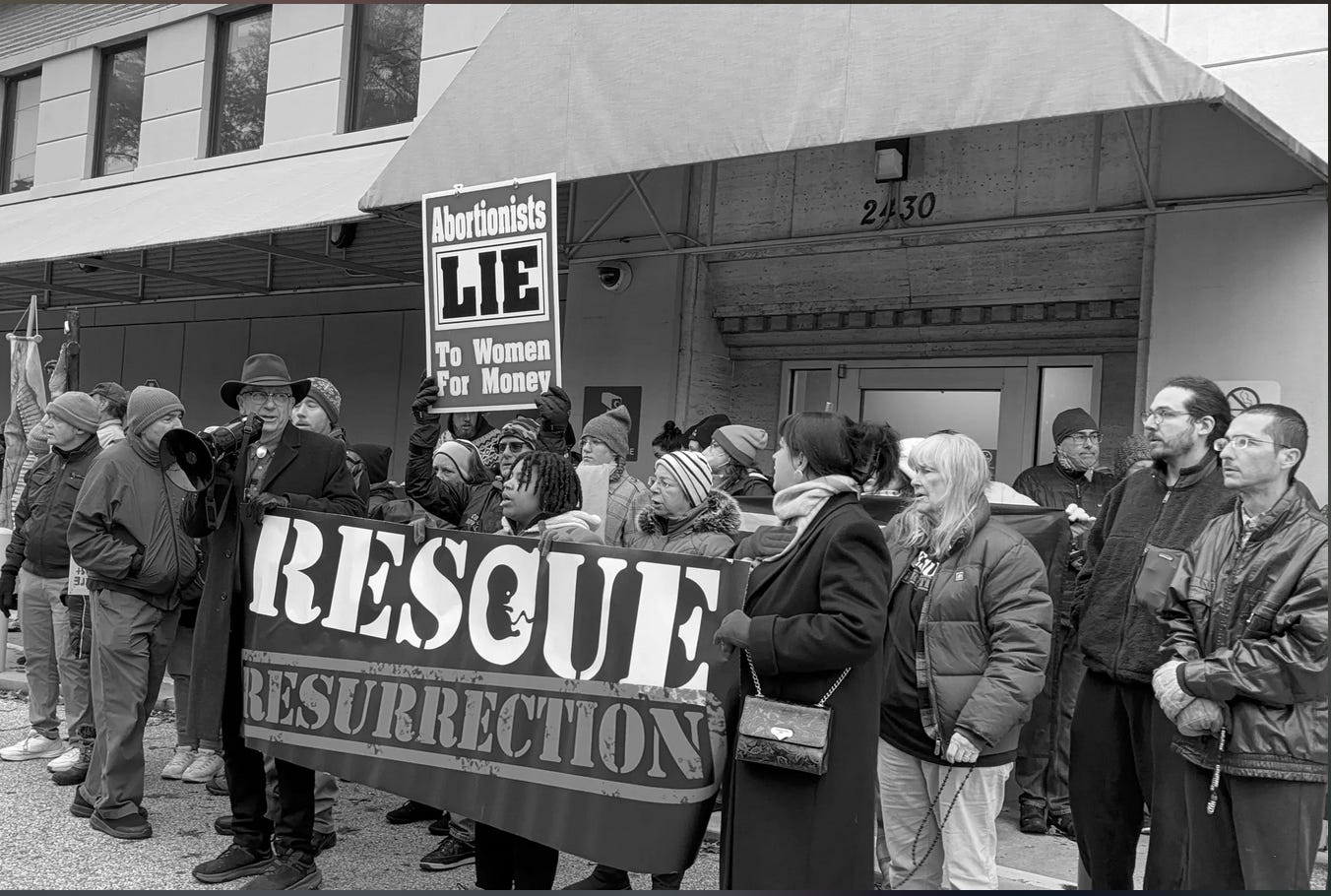
On Thursday, the Catholic Herald published an opinion piece headlined “As nation reflects on Roe, remember timeless Catholic teaching”—that is, abortion is murder. In Washington, Rescue Resurrection held a sit-down in front of Health & Human Services in Washington; 20 demonstrators were taken politely into custody. Rescue Resurrection is the new iteration of Operation Rescue, the terrorist group whose decades-long campaign of violence against abortion providers led to the murder of Kansas OB-GYN George Tillis in 2009.
In the states, anti-abortion legislators are working tirelessly to further restrict and criminalize abortion. UCLA law professor Mary Ziegler told CNN that Republicans have “nothing to lose and everything to gain” by pressing for ever-harsher laws. After all, their ultimate goal is not just to ban abortion but to give the fetus full legal personhood. If the fetus is a person, its mother is at best a vessel and, at worst — should she miscarry or have an elective abortion — a murderer
Women, queers, and people with disabilities are often the first to be sacrificed by an authoritarian regime. At the same time, the politics of the body are sidelined as a “cultural”—read: trivial—issue, compared to, say, the destruction of the postwar rules-based global order.
At the moment, this seems reasonable. But it is a mistake to see these two phenomena, these two kinds of issues, as separate. The slow, then sudden, demise of Roe presaged the rise of a state that would jettison all concern for human need and apply itself exclusively to policing; it remains a triumph for a movement whose goal is to wrest away every freedom, political or corporeal.
Thanks for this piece. I've been concerned about the potential prosecution of people who have had miscarriages or abortions given the direction of things. While some states have some shield laws, it is hard to fully shield medical records. (Algorithms to redact records based on diagnostic or procedure codes would not necessarily redact clinical notes mentioning a history of miscarriage or abortion in visits for non-reproductive manners.) I wish shield laws also were being passed with legislation explicitly giving patients permission to opt out of health information exchange. I wish more information about health privacy was available for patients too.