
04.15.26
In defense of draft-dodging

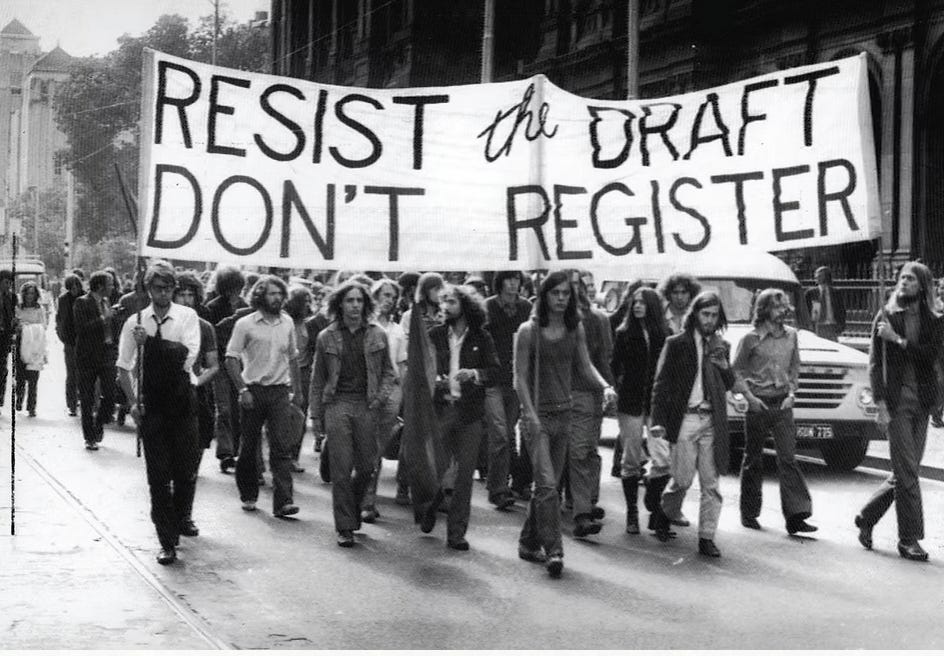
There are many things I loathe about Donald Trump, but being a draft-dodger is not one of them.
I am under no illusion that he got a deferment (bone spurs) for reasons of conscience, since he has no conscience. He is certainly a coward, but not wanting to fight in Vietnam did not make him a coward. Anyone who was not scared to put his body into that inferno was either lying or an idiot. (Yes, Trump is a liar and an idiot … but you get my drift.) I hold it against no one for refusing to fight. As with abortion, there is no wrong reason to avoid the draft.
On March 30, the Selective Service System, which maintains a pool of eligible men for military deployment, proposed automatic registration, rather than leaving it up to the individual, as is done in many states. Most men between 18 and 25 residing permanently in the U.S. are required to register with the SSS, and it’s a federal offense to fail to. This includes immigrants, documented, undocumented, and in the process of obtaining documentation; and (now) transgender people assigned male at birth. You know: so they can defend our freedoms.
Women are not required to register, and that’s not going to change as long as the “department of war” is run by Pete Hegseth, who has made it a holy crusade to cleanse the armed forces of women, transgender people, and people of color (this last category comprised about half the active duty personnel in 2022). I’ve never objected to being left out of the draft; the equal right to kill is not my feminist cause.
The proposed change in SSS regulations is meant to save money, and maybe it will. But it brings up other questions.
First, why is it easy to register people to fight and impossible to register people to vote? Until January 2025, birthright citizenship was not in dispute. All this time, voter registration could have been done at birth, as it is in many other countries. Once (we hope) Trump loses his Supreme Court case, it could be done again.
Second, what about immigrants? What does the administration want? To deport them all, or to send them to war? Or both? Czars and other despots have historically sent their undesirables to the front lines, where they were nearly guaranteed to die. In Vietnam, while Black soldiers made up 10 to 12 percent of the armed forces (the rest were mostly working-class white men), a quarter of the soldiers in the most lethal combat were Black.
The third question sprang to many minds the instant the new automated draft was announced: Does this signal a ground war in Iran — and a draft?
The official answers are no and no. But asked if conscription was the next step, Press Secretary Karoline Leavitt said the president “is wisely keeping all his options on the table.”
Not so wisely.
The draft both equalizes the fear of dying in combat and exposes how unequal the system is. Before a lottery was instituted in 1969, conscription was carried out by local draft boards, which were made up of a few, usually white, men. This made the selective service system anything but systematic. People of color and white working-class men without education were selected to fight and die in Vietnam. College students, family breadwinners, people in certain jobs, the psychologically or physically “unfit,” and those with money and connections, like Donald Trump, got off. A lottery does not eliminate deferments.
No matter who ends up in uniform, however, the anxiety it inspires in every young man and every parent, child, friend, spouse, or lover of a young man is one of the surest-fire ways of uniting a nation against a war. It was central to ending the Vietnam war.
In fact, avoiding the draft and helping others to do it was an important tactic of the antiwar movement. Public draft card burning was a dramatic form of civil disobedience. My father, a psychologist, was a draft counselor. One evening a week, for many years, he met with young men to figure out ways they might seem too crazy to deploy, and thus obtain a 4-F, “unfit to serve,” deferment. He taught them how to appear schizophrenic. He suggested not bathing or brushing their teeth for a few weeks or collecting their shit in a garbage bag and dumping it on the draft officer’s desk. Draft-dodging was not without risk. If you were caught scamming, you could go to prison.
Of course, when one man did not go to Vietnam, another took his place. This is one source of the enduring antagonism of white working-class men, including union members, toward the left, which long was and still ought to be their political home. The Vietnam war also radicalized many Black soldiers, for good reason, who came home and joined the Black Power movement. As Muhammad Ali said in 1966, when he was asked why he refused conscription: “No Vietnamese ever called me ‘nigger.’”
As a practical matter, automatic registration might not make much difference. But politically? That’s another story. In the 1960s, the draft focused many minds on what the hell we were fighting for on the other side of the world. The answer that became clearer and clearer was: the needs and desires of the political elites and the military-industrial complex. If Trump’s assault on Iran was at all thought out, and that is questionable, it was intended to serve the same interests. Unfortunately for them, it’s not working out so well for either the political elites or for capital.
In 2026, Americans are in a fiercely anti-war mood. The draft could be the last stretch of rope on which this administration hangs itself.
But a draft to require a year or two of national service for everyone could be a very good thing.
Well said.