
05.05.26
Buffalo politics

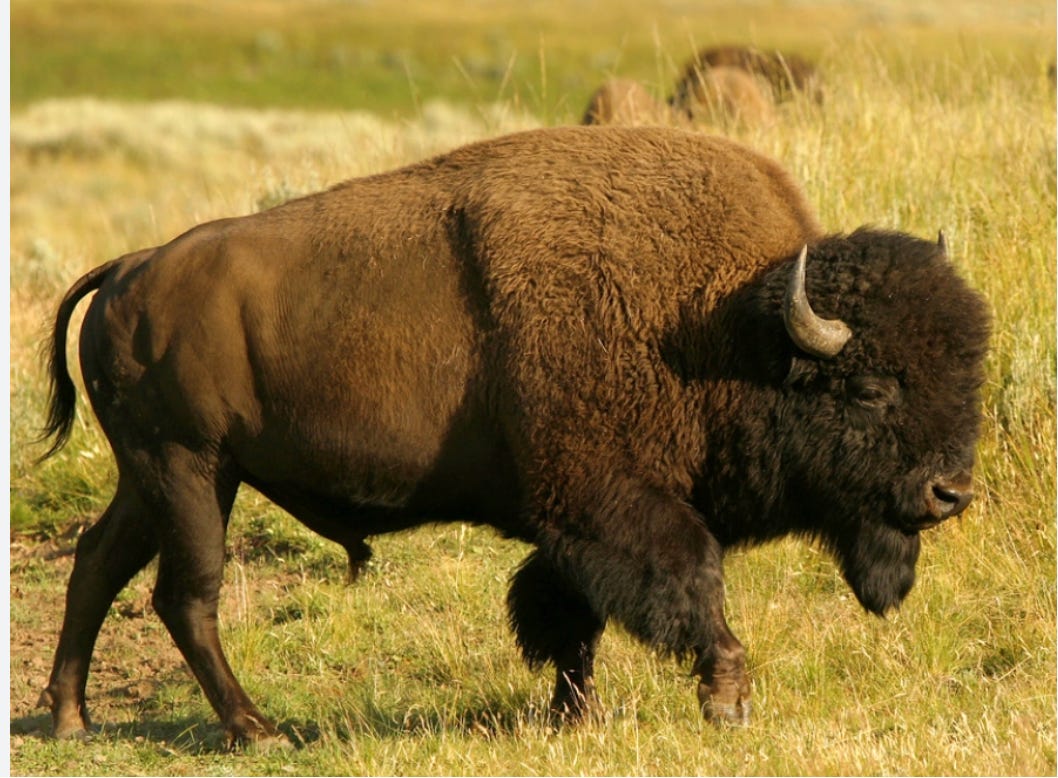
The man Donald Trump most often cites as his political hero and model is Andrew Jackson, the seventh U.S. president. Jackson’s portrait hangs in the Oval Office, and if Trump gets his Garden of Heroes in a redesigned West Potomac Park in Washington, Jackson’s likeness will be one of its 250 life-size statues.
Jackson was a slave trader, a notoriously harsh slave owner, and a champion of the Westward expansion, which he believed necessitated the relocation of the new territories’ indigenous inhabitants. His signature legislation was the Indian Removal Act of 1830, which displaced about 60,000 Native Americans from the southeast to west of the Mississippi, either by treaties that were later broken, or by force, resulting in the shredding of tribal cohesion, thousands of deaths, and trauma that endures to this day.
Part of the program to demoralize and physically weaken the Native Americans was the slaughter of the American bison, on which their lives depended. In the second half of the 19th century, white professional hunters, supported by the U.S. Army and railroad companies, slaughtered 30 to 50 million buffalo, reducing their numbers to a few hundred. In the 20th century, conservationists brought them back from near extinction, breeding over 350,000 animals from 77 survivors.
Now, as part of its project to cede the national parks and federal lands to mining companies, commercial loggers, and agribusiness, the Trump administration is revoking the leases held by the environmentalist nonprofit American Prairie of 3.2 million acres of federal land in northern Montana, where it grazes 900 bison. Native Americans support American Prairie’s project for obvious reasons, and many presidential administrations, including Trump’s first, renewed the permits. But this winter the U.S. Bureau of Land Management did not.
In 1934, to put an end to decades of violent range wars over grazing and water rights and livestock ownership, Congress passed the Taylor Grazing Act, which created grazing districts and leased them under federal direction. In the 1970s, environmental law began to regulate the permits with the aim of preventing overgrazing and soil erosion. Many ranchers, who are overwhelmingly right-wing libertarians, have been unhappy about all of it.
It’s not a simple story. In one sense, U.S. federalization was the opposite of the enclosure of the commons in Britain from the 14th through the 19th centuries, when communally held agricultural lands were privatized and fenced off. In the U.S., the communally held lands that might have been privatized were taken over for public protection and use. But for the ranchers, the results were similar: they now have to pay to graze on land they or their ancestors might once have used for free.
The Trump administration doesn’t care about soil erosion, which has been exacerbated by climate change, which it doesn’t believe in. It has contempt for anything so “woke” as the protection of endangered species. It wants only to reward its corporate sponsors and let the devil take the hindmost, whether those are people or animals, grasslands or forest, water or air.
And the buffalo? As a symbol of the American West, the magnificent creature is both noble and historically compromised. But Trump doesn’t care about any of that either. He is working to ensure that the only image representing America is his own.