
11.17.25
Sleeping while homeless

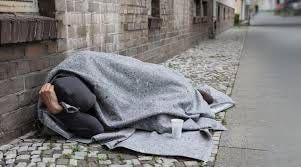
Now it strikes me as a metaphor. An important story gets lost in the hubbub of the shutdown and the election, both of which have life-and-death impacts on the invisible or forgotten subjects of the story — in this case, the unhoused.
On October 29, the New York Times ran an article on a new homelessness policy in Salt Lake City, Utah, written by Ellen Barry, an astute reporter on mental illness, and Jason DeParle, who has authored one book on migration and one on welfare, both masterpieces of meticulous, intimate reportage. The piece begins:
To glimpse the future of homelessness policy in the age of President Trump, consider 16 acres of scrubby pasture on the outskirts of Salt Lake City where the state plans to place as many as 1,300 homeless people in what supporters call a services campus and critics deem a detention camp.
The city will now give people with mental illnesses including drug or alcohol addiction two “options”: involuntary, indefinite civil commitment in the “accountability center”; or arrest and jail.
For several decades homelessness and mental-health professionals have favored “housing first” approaches. Housing doesn’t cure mental illness, they say, but you can’t treat mental illness if a person is trying to stay alive without a bed or a shower, contending with theft, violence, and police harassment. I would add that there’s a lot of snow in Utah.
The name “accountability center” makes clear what Salt Lake City’s officials think the problem is. Randy Shumway, chairman of the state Homeless Services Board, told the Times that the city is cracking down on a harmful “culture of permissiveness.” The program of compulsory “rehabilitation” aims for “human thriving,” he said. Its priorities:
We are in the business of lives, of humans, of souls. We can’t brick-and-mortar our way out of this.
The homeless detention center embodies the Trump regime’s strategy for dealing with the vulnerable and the marginal.
First, vilify them. War refugees are terrorists, people fleeing poverty are rapists. The homeless mentally ill choose getting high over paying rent. Rather than vulnerable to harm, they are harming the law-abiding, hard-working housed population.
This thinking reverses a two-century-long transformation of “badness to sickness,” as Peter Conrad described the medicalization of antisocial or merely odd behaviors. Addiction, once considered a sin, came to be understood as an illness. In Mormon Utah, addiction is again a sin. And since it is, the reasoning goes, the state should stop coddling addicts by allowing them to remain addicted.
Next, criminalize them. Anyone unable to afford an apartment — or attain the almost unattainable grail of legal immigrant status — is a scofflaw and a freeloader. The lack of livable wages, affordable housing, and mental health treatment in a country whose wealthy take private space flights and rent entire cities for their weddings is the fault of the people who don’t earn enough for food, shelter, and healthcare all at once.
Vulnerability is sin. And sin is crime. Homelessness is the fault of the homeless. So fine, arrest, detain, or incarcerate the homeless.
Then, disappear them. Deport undocumented immigrants. Lock up the homeless in remote concentration camps. You may remember that when Trump sent the military to occupy Washington, DC, one of its first acts was to raze over 50 homeless encampments.
The homeless had to move out “IMMEDIATELY,” Trump posted on Truth Social. “We will give you places to stay, but FAR from the Capital.” The White House told reporters that homeless Washingtonians could either be taken to a shelter and get addiction or mental health services or “be susceptible to fines or to jail time.”
In response, unhoused people tried to remain on the move and out of sight.
Salt Lake City’s impunity—indeed, its pride—in banning sleeping-while-destitute is a direct outcome of the Supreme Court’s ruling in June 2024, in City of Grants Pass, Oregon v Johnson. The majority found that the city’s ordinance against sleeping outdoors, even though there were insufficient shelter beds, did not constitute unconstitutional cruel and unusual punishment. The ordinance is especially perverse, as it allows people to sleep in their cars or in a public park if they have a legal address. Only if they do not, and cover themselves with as little as a blanket, will they be fined or arrested.
In her dissent Justice Sotomayor, joined by Kagan and Jackson, wrote:
Sleep is a biological necessity, not a crime. For some people, sleeping outside is their only option. . . . For people with no access to shelter [the ordinance] punishes them for being homeless.
Sotomayor noted what would become a pattern during Trump II: The court ignores a policy’s demonstrated harms to real humans and instead determines that any limit on policy or law enforcement places an undue burden on the government’s ability to do its job (even if its job is, or should be, illegal). In Grant’s Pass, Sotomayor continued:
The majority focuses almost exclusively on the needs of local governments and leaves the most vulnerable in our society with an impossible choice: Either stay awake or be arrested.
Poverty is not a crime. Need is not sin.
Souls, being ethereal, may not require brick and mortar to shelter them. But human bodies do.