
12.10.25
SCOTUS okays book-banning

This week, the Supreme Court declined to hear a challenge to a ruling by the 5th Circuit federal appellate court in New Orleans, allowing government officials in Llano County, Texas, to ban books from the public library.
After a group of citizens sued the county for banning the books (before that, officials had replaced the entire school board with pro-censorship members), a federal district court ordered that they be returned to the shelves. Then the 5th Circuit — the most conservative in the country — overturned that ruling. And SCOTUS let it stand.
Fifth Circuit Judge Stuart Kyle Duncan, a Trump appointee, wrote the majority opinion. The right to information could not be invoked to prohibit government interference in decisions about a library’s collection, he said, because a library’s collection is government speech.
“All Llano County has done here is what libraries have been doing for two centuries: decide which books they want in their collections,” he wrote.
Yes, libraries have been doing that for centuries. Most are relatively small, so librarians must be selective. If they don’t have a book a patron requests, however, they may order it or try to get it by inter-library loan. In other words, they promote freedom of expression and information.
Libraries are not the government. They are public institutions that protect patrons’ First Amendment right to make up their own minds about what to read, watch, or think.
And anyway, Duncan opined, “If a disappointed patron can’t find a book in the library, he can order it online, buy it from a bookstore, or borrow it from a friend.”
This is not only a massive blow to freedom of speech. It is a blow to the idea of the public sphere. In effect, Duncan is saying that the market is the forum and the government is its police. And—the essential tenet of neoliberalism—that the market can provide everything the public sector can provide, only better.
And if a person) can’t afford to buy books; b) doesn’t know what books they want and goes to the library to find out; c) does not have friends they can borrow books from; or d) prefers to keep their reading preferences private? Not the county’s problem.
Some of the books on Llano County’s list have been banned many times in many places since the 1980s, when the Christian right started trying to decide what everyone else read, saw, and thought. In the past, the target was always “obscenity” and the rationale was the protection of children. Among the most banned is Maurice Sendak’s classic children’s book In the Night Kitchen, because the protagonist, Max, tumbles through a dream naked. “Blasphemy” including witchcraft, has also been a no-go for the Christians. And while self-appointed censors have in recent decades gone after books in which the main characters are Black or brown (Toni Morrison is a perennial object of crackdowns), this time they’re simply after Black history. One of the listed books is Caste: The Origins of Our Discontents, by the Pulitzer Prize winning journalist Isabel Wilkerson, which has been widely praised for its original analysis of America’s bedeviled relationship to color.
Now adults also have to be protected. Or punished for their wickedness?
Until recently, the bans have been overturned. In fact, since the 1950s, the Supreme Court has expanded the domain of Constitutionally protected expression to include a broader and broader range of content, including, for instance, books that had been banned as “obscene,” if they had literary, scientific, or artistic merit and could be deemed acceptable according to “community standards.” A series of rulings under Supreme Court Chief Justice Earl Warren resulted in the freeing of such perennially banned titles as the 18th century erotic novel Fanny Hill, D.H. Lawrence’s Lady Chatterley’s Lover, and Tropic of Cancer, by Henry Miller.
The mainstream press did not provide the full list “because the complete court filings weren’t released, and reports name only select titles,” according to Newsweek.
But in May, Education Week did:
Caste: The Origins of Our Discontents by Isabel Wilkerson
They Called Themselves the K.K.K.: The Birth of an American Terrorist Group by Susan Campbell Bartoletti
Spinning by Tillie Walden
Being Jazz: My Life as a (Transgender) Teen by Jazz Jennings
Shine by Lauren Myracle
Under the Moon: A Catwoman Tale by Lauren Myracle
Gabi, a Girl in Pieces by Isabel Quintero
Freakboy by Kristin Elizabeth Clark
In the Night Kitchen by Maurice Sendak
It’s Perfectly Normal: Changing Bodies, Growing Up, Sex and Sexual Health by Robie H. Harris and Michael Emberley
My Butt Is So Noisy! by Dawn McMillan
I Broke My Butt! by Dawn McMillan
I Need a New Butt! by Dawn McMillan
Larry the Farting Leprechaun by Jane Bexley
Gary the Goose and His Gas on the Loose by Jane Bexley
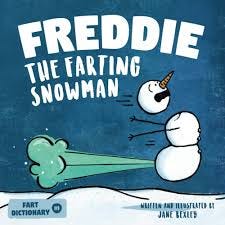
Freddie the Farting Snowman by Jane Bexley
Harvey the Heart Had Too Many Farts by Jane Bexley
You may notice that of the 17 books, seven concern farting. Now that’s something the citizens of Llano County need their government to crack down on.
Back in the 1950s, the very period when the conservatives want to return to, Hollywood made the movie "Storm Center" (1956) [ https://www.imdb.com/title/tt0049800 ]. In movie, Bette Davis played a small town librarian who was pressured by the town council to remove a book on Communism from the library shelves.
The RW drummed up culture wars to keep itself in power, and has returned us to this era, but with different targets, now extended to DEI, women, and even science at the HHS. How long before we see public book burnings as they were performed in Nazi Germany? This is all of a piece with the blatant RW takeover of the media, which will prevent even the publishing of books and other media about these subjects. We need to keep being reminded of where we are headed, so your posts on substack, and your pieces in The Guardian, are important, lest the RW propaganda becomes the accepted social norm.
The IMDB reviews of "Storm Center" were good, and reflected that this was about the dangers of McCarthyism. This is what one reviewer wrote about the movie (which was given an 8/10 rating):
"...
STORM CENTER is about politics and censorship. Davis is a librarian, and is only concerned in running her town library as well as possible, and in encouraging literacy among the children of the town. One of the children is played by Kevin Coughlin, a wonderful child actor who would grow into a capable actor before being killed in a traffic accident when only 30 years old. Kevin is bookish - too bookish according to his "know nothing" blue-collar father (Joe Mantell). There is a struggle or tug of war between Mantell, wanting his son to be more like a typical boy (i.e. a sports oriented kid) and Davis, who wants Kevin's mind to grow.
Adding to her problems is that a book in the library that Davis has put out is controversial. A number of citizens would like it removed. Brian Keith, a new member of the city council, decides to take this up as a political issue (for his own advantage, of course). Soon, all sorts of pressures are put on Davis to get rid of the nasty book, and she refuses to do so. The pressures turn nastier and nastier. Despite the support of an old friend (Paul Kelly), Davis faces dismissal. In the meantime Kevin has been affected by the near hysteria sweeping through the town. His father is pretty happy about that - maybe his son will become normal. The father lets Kevin know that the problem is the library itself. So Kevin, in his own hysterical state, sets fire to the town's library.
I saw this film only once, back in the 1970s. The arson sequence always remained with me, for the director/writer Daniel Taradash, showed the names of the titles of the burning books throughout the building. There is a build-up in the titles, as most are classic or well known works, but the last is a life of Jesus Christ - certainly the last person most right wing American fanatics would think of destroying (at least in their claimed rhetoric) from among all potential targets.
There is a sense of shame at the conclusion from Keith and the townspeople, but Davis shows no triumph over them. She simply starts planning to rebuild the library, and starts planning to help Kevin regain his normal state of mind.
It was a fine piece of film, and it is a pity it is so little known or remembered. More people should have a chance to watch it and decide for themselves about it."